

Microfiber towels stand as a staple tool in today’s car detailing work. Workers use them to dry painted panels. Workers use them to wipe away polish. Workers use them to clean glass. Workers use them to tidy interior surfaces. Nearly every detailing step relies on microfiber.
Not every microfiber towel delivers the same results.
Two towels can look almost identical. One feels softer to touch. It picks up more water. It leaves fewer streaks. It keeps its quality after many washes. The other turns rough quickly. It loses the ability to soak water. It leaves loose fibers on cleaned surfaces.
So, what really makes a high-quality microfiber towel for car detailing? The answer is not simply “higher GSM.” A solid detailing towel comes from a balanced set of traits. These traits include fiber quality. These traits include fabric build. These traits include soft texture. These traits include water uptake. These traits include edge treatment. These traits include design made for specific jobs.
Quality Starts with the Microfiber Yarn
Fiber material sets the baseline performance of any microfiber towel.
Automotive microfiber towels usually combine polyester and polyamide. Polyester gives the cloth strength. It holds up through repeated use. Polyamide creates a softer feel. It helps the fabric take in moisture.
Looking only at the polyester and polyamide ratio cannot show the full picture.
Yarn quality changes towel behavior. How thin makers spin these fibers changes towel behavior. How fully they split fibers during production changes towel behavior. All these details shape how the towel works.
Properly split microfiber forms thousands of ultra-fine strands. These strands expand the contact area between cloth and surface. The towel traps dust, water, polish leftover film and dirt. It does not just slide contaminants across the panel.
This difference creates a clear feel when people use quality microfiber on cars.
It cleans more effectively. Users do not need to press hard against surfaces.
Softness Is Especially Important for Automotive Paint
People doing professional car detailing worry most about unwanted scratches or swirl marks.
Clear coat layers can scratch easily. Piano-black trim can scratch easily. Chrome parts can scratch easily. Shiny interior panels can scratch easily. Poor cleaning materials leave marks on these surfaces.
A reliable microfiber detailing towel should feel soft. It should feel smooth. It should bend easily.
Softness goes beyond hand touch alone.
The whole fabric build plays a role.
Fiber length shapes surface safety. Fabric density shapes surface safety. Surface structure shapes surface safety. Edge treatment shapes surface safety. All of these decide how gently the towel glides over paint.
People pick softer, fuller microfiber for work on sensitive paint. Common tasks include final buffing, quick detailing and wax removal.
Tougher work needs a shorter, sturdier pile. This works for wheel cleaning or lower body panels covered in heavy grime.
Professional detailing work often needs more than one style of microfiber towel.
GSM Matters — But It Is Not the Only Measure of Quality
GSM, or grams per square meter, gets discussed often when people talk about microfiber towels.
This number shows fabric weight for each square meter. It cannot tell you if a towel is good or bad on its own.
A 500 GSM towel is not automatically better than a 300 GSM towel.
The right GSM value depends on the towel’s intended use.
Lower and medium GSM towels are simple to handle. They work well for: Interior cleaning Glass cleaning Removing polish General-purpose wiping
Higher GSM towels are widely chosen for: Drying Final buffing Quick detailing Delicate paintwork
Weight alone is not the key. Weave style and fiber structure need to fit the task at hand.
Professional buyers should not chase the highest GSM number available. They pick towel construction matched to each detailing task.
The Weave Changes the Performance
Makers weave or knit microfiber into many fabric styles. Each style brings unique working properties.
This difference separates basic microfiber cloths from towels built for professional detailing.
Twisted Loop
Twisted-loop microfiber has grown very popular for drying cars.
Long twisted strands collect water efficiently. The towel soaks up large amounts of moisture quickly.
It fits large painted surfaces after vehicle washing.
Plush Microfiber
Plush microfiber has a soft, fluffy pile.
It is commonly used for: Buffing wax Quick detailer Final finishing Paint care
Its deeper pile also lifts tiny particles away from vehicle surfaces.
Short-Pile Microfiber
Short-pile towels create direct contact with the surface.
They are well suited to:
- Interior cleaning
- Polish removal
- General wiping
- Utility cleaning
Users gain easy control. These towels usually deliver steady cleaning power.
Waffle Weave
Waffle weave microfiber carries a textured surface. This texture catches moisture while keeping good contact with panels.
People often use it for glass and drying work.
Suede or Smooth Microfiber
Smooth microfiber fabrics have an extremely low pile. They shine in jobs that demand zero stray fibers.
Typical applications include:
- Glass
- Mirrors
- Screens
- Glossy interior panels
No single weave works best for every situation.
The best fabric build follows the task assigned to the towel.
High Absorbency Is More Than Just a Selling Point
Absorbency sits among the top performance requirements for microfiber drying towels.
A good towel pulls water off vehicle panels fast. It does not just push water around the surface.
Fewer wiping passes become necessary. The drying process becomes faster and more efficient.
Water absorption comes from multiple features working together:
- Fiber composition
- Fiber splitting
- Fabric construction
- GSM
- Pile structure
- Finishing process
Two towels with identical size and GSM can still perform very differently.
Water pickup speed carries equal weight with total liquid holding capacity for professional drying products.
Fast-absorbing towels greatly improve the user’s detailing experience.
A Quality Towel Should Leave Minimal Lint
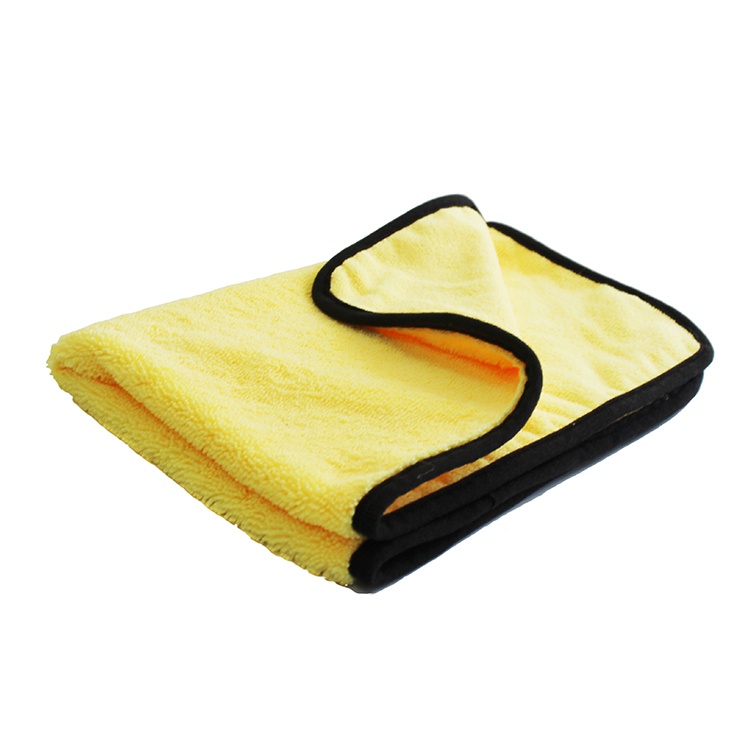
Cleaning a surface only to spot leftover tiny fibers creates frustration for users.
Lint stands out clearly on:
- Glass
- Mirrors
- Dark paint
- Piano-black trim
- Screens
Low-lint performance acts as an important quality marker for automotive microfiber goods.
Stable yarn helps cut loose fibers. Careful knitting or weaving helps cut loose fibers. Controlled finishing helps cut loose fibers. These steps reduce fiber shedding during use.
Low lint becomes critical for glass towels. Even small fiber bits ruin the final clean look.
Edge Design Is Often Overlooked
The edge of a microfiber towel may look like a minor detail. It affects durability. It affects surface safety.
Different edge builds fit different product positioning.
Common options include:
- Overlock stitching
- Fabric-bound edges
- Ultrasonic-cut edges
- Laser-cut edges
- Edgeless designs
- Pressed scratch-free edges
Traditional stitched edges hold up well for general cleaning work.
Buyers of premium paint-care towels often prefer soft edges or edgeless builds. Hard stitching cannot easily touch and scratch painted surfaces with these designs.
Smart edge design lifts the towel’s overall appearance. It supports a higher-end retail product look.
Durability Matters for Professional Use
Professional detailers reuse microfiber towels repeatedly.
A quality towel keeps steady performance after many wash cycles.
Poor-quality towels change over repeated use.
They may:
- Become hard
- Lose absorbency
- Shed fibers
- Stretch or distort
- Lose their original shape
- Develop damaged edges
High-quality microfiber keeps a balanced mix of softness, strength and function through repeated use.
Wash durability carries special weight for brands, importers and distributors. It shapes customer satisfaction directly.
A towel that works well when new but breaks down fast cannot build long-term trust for a product line.
One Towel Cannot Do Every Detailing Job
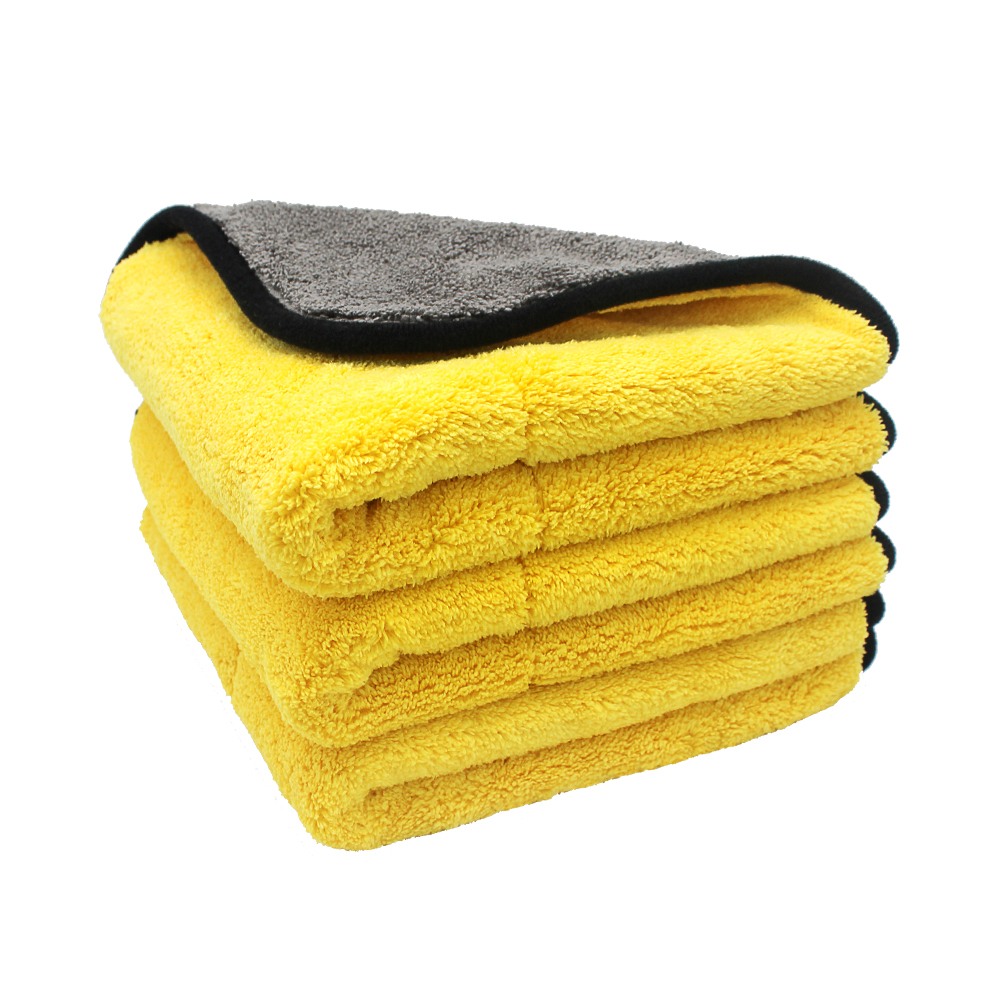
Many people make a mistake while building automotive microfiber product lines. They try to use one towel for all cleaning tasks.
Professional detailing breaks down into specialized steps.
Different vehicle zones demand different towel features.
For example:
- Vehicle Drying
High absorbency and larger towel sizes are important. Twisted-loop microfiber is a popular option.
- Paint Buffing
Soft, plush microfiber helps remove wax, sealant and quick detailer while remaining gentle on the paint.
- Glass Cleaning
Low-lint and streak-free performance are the priorities. Smooth, waffle or specialized glass microfiber works well.
- Interior Cleaning
A medium or short pile is often more practical for dashboards, door panels and general surfaces.
- Wheel and Utility Cleaning
Durability and cleaning power are usually more important than an ultra-soft surface.
Building a microfiber product range around real detailing tasks makes the line more useful. Customers can understand these products easily.
Color Can Also Improve Detailing Efficiency
Many professional detailers pick different towel colors for different vehicle areas.
One color may serve paintwork. Another serves interior surfaces. Another serves wheels.
This simple method lowers cross-contamination risk. It makes towel organization simpler.
Color coding also helps automotive brands and retailers build a more professional product lineup.
People can tell different functions apart quickly. This works even when multiple microfiber towels share similar sizes.
What Should Buyers Look for When Sourcing Microfiber Towels?
Importers, distributors and private-label car care brands need more than price and GSM comparisons for towel sourcing.
A full evaluation checklist includes:
- Fiber composition
- Yarn quality
- GSM consistency
- Towel size
- Fabric construction
- Softness
- Absorbency
- Lint performance
- Edge finishing
- Color fastness
- Washing durability
- Packaging
- Application
Top performing microfiber products are not always those with the most impressive written specs.
Their specifications match real-world use cases.
A good drying towel removes water efficiently. A good glass cloth leaves a clear, streak-free surface. A good buffing towel stays soft and safe on paint.
Performance must match the intended purpose.

Developing the Right Microfiber Towel for Your Market
Different markets, brands and sales channels need different microfiber products.
A professional detailing brand may focus on premium high-GSM towels with specialized fabric builds. Supermarket or promotional product lines may value versatility, packaging and competitive pricing more.
Customization carries importance for this reason.
At PHOEBETAI, we make and develop microfiber products for varied automotive cleaning applications, including: Microfiber detailing towels Twisted-loop drying towels Glass cleaning cloths Microfiber wash mitts Polishing and buffing towels Interior cleaning cloths Multi-purpose automotive microfiber products
We adjust sizes, GSM, colors, fabric builds, edges and packaging following customer requirements.
OEM and private-label projects also receive customization. Design follows the positioning of the customer’s car care range.
Final Thoughts
No single specification defines a high-quality microfiber towel for car detailing.
Great results come from a mix of suitable fiber, GSM, weave, softness, absorbency, lint control, edge construction and durability.
Most importantly, the towel gets built for its assigned job.
Automotive brands and professional detailing suppliers gain clearer insight from learning these differences. They build a microfiber lineup that delivers stronger cleaning results. End users get a better experience.
Material and construction matched properly to the application unlock great value. Even a simple microfiber towel becomes one of the most useful tools inside a car detailing kit.